
Andrew
Martyrdom and the X-Shaped Cross
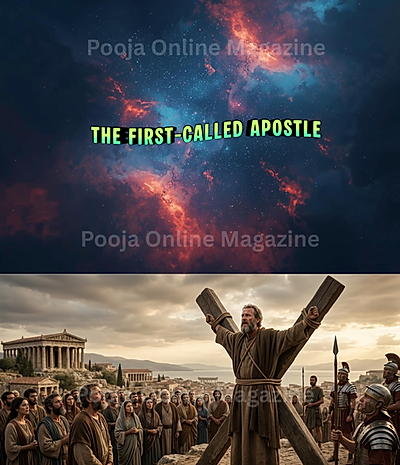
While Peter often takes the spotlight in historical narratives, his brother Andrew holds a unique place in history as the very first of the Twelve Apostles to follow Jesus. His life is a testament to the power of personal connection and a missionary spirit that spanned from the shores of Galilee to the distant frontiers of the ancient world.
The Fisherman of Bethsaida
Andrew was born in Bethsaida, a fishing village on the Sea of Galilee. Like his brother Simon Peter, he was a professional fisherman, accustomed to the grueling labor of the nets and the deep-seated traditions of his Jewish heritage.
However, Andrew was also a seeker. Before meeting Jesus, he was a disciple of John the Baptist. When John pointed toward Jesus and declared him the "Lamb of God," Andrew did not hesitate. He followed Jesus immediately, spent a day in conversation with him, and then rushed to find his brother, famously declaring, "We have found the Messiah." Because of this, the Eastern Orthodox tradition refers to him as Protokletos, meaning "The First-Called."
A Quiet but Pivotal Leader
In the biblical accounts, Andrew is often seen bringing people to Jesus. It was Andrew who found the young boy with five barley loaves and two fish before the feeding of the five thousand, and it was Andrew who assisted Greek travelers seeking an audience with Jesus. He was known for his approachable nature and his ability to bridge gaps between different cultures.
Missionary to the "Ends of the Earth"
Following the Pentecost, Andrew’s mission took him far beyond the borders of Judea. Early Christian historians, including Eusebius, record that Andrew traveled to Scythia, an area encompassing modern-day Russia, Ukraine, and the shores of the Black Sea. This has led to him being honored as the patron saint of several nations, including Russia and Greece.
He also preached extensively in Asia Minor (modern-day Turkey) and eventually settled in the city of Patras in Achaea, Greece. It was here that his influential preaching began to draw the ire of the Roman authorities.
Martyrdom and the X-Shaped Cross
In approximately 60 AD, the Roman Proconsul Aegeas ordered Andrew to be executed for his refusal to renounce his faith. Andrew was sentenced to crucifixion, but like his brother Peter, he requested a variation in the method.
Andrew was bound—rather than nailed—to a decussate cross, commonly known today as an X-shaped cross or the Saltire. This was done to prolong his suffering. According to tradition, Andrew did not use his final hours to lament his fate. Instead, he reportedly hung upon the cross for two days, using the time to preach to the crowds that gathered, encouraging them in their faith until he finally passed away.
Legacy and the Saltire
The "Cross of St. Andrew" became one of the most recognizable symbols in the world. By the 9th century, he was adopted as the patron saint of Scotland, and his X-shaped cross became the white-on-blue flag known as the Saltire.
Andrew is remembered today not just as a martyr, but as the "introducer"—the man who was content to work in the background, constantly bringing others into the fold.
